

Homeowners across New York, New Jersey, and Connecticut ask us this question constantly:
“It’s just a home office (or gym, or playroom). It’s not a bedroom — so we don’t need an egress window, right?”
In most cases, that assumption is wrong.
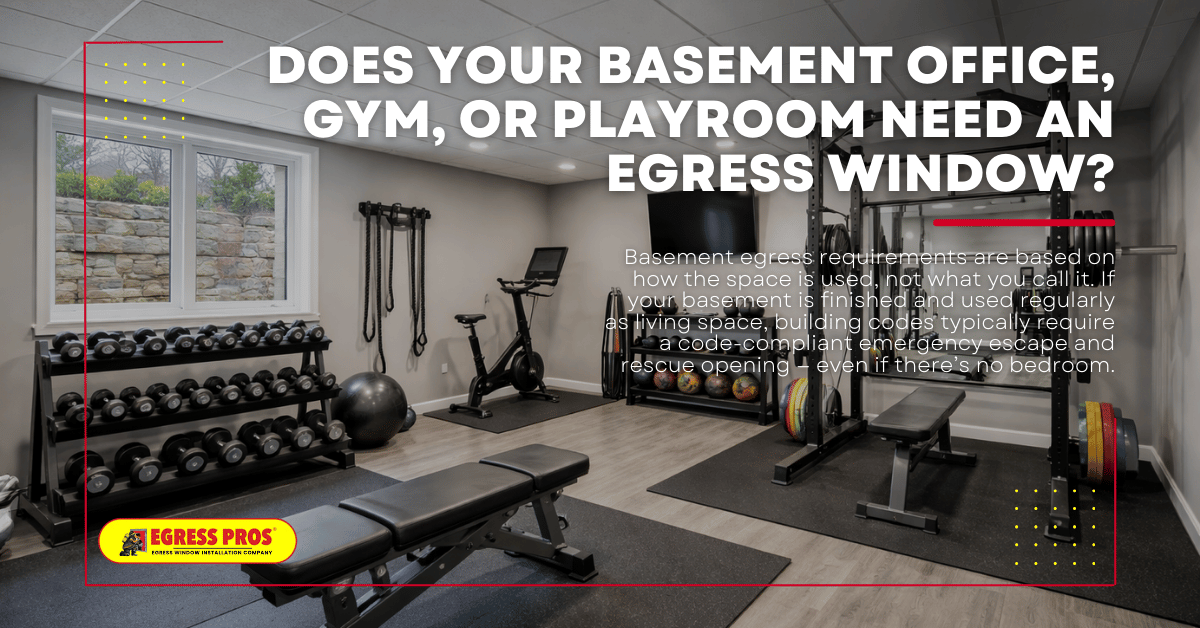
Basement egress requirements are based on how the space is used, not what you call it. If your basement is finished and used regularly as living space, building codes typically require a code-compliant emergency escape and rescue opening — even if there’s no bedroom.
Let’s break this down clearly, without the confusion.
The Basement Egress Rule Most Homeowners Misunderstand
Residential building codes enforced throughout NY, NJ, and CT are based on the International Residential Code (IRC).
The core rule is simple:
Any basement that contains habitable space must have at least one emergency escape and rescue opening.
That opening can be:
- A properly sized egress window, or
- A direct exterior exit such as a basement walkout door
This requirement applies to the basement as a whole, not just bedrooms.
Bedrooms are a stricter category — but they are not the starting point.
What Counts as “Habitable Space” in a Basement?
This is where most homeowners get tripped up.
Basements That Are Considered Habitable (Egress Required)
If your basement is finished and used regularly, it is almost always classified as habitable space. Common examples include:
- Home offices used for remote or hybrid work
- Home gyms with exercise equipment and regular use
- Playrooms or family rooms
- Media rooms or entertainment spaces
- Finished recreation areas
If the space has drywall, flooring, lighting, heat, and people spend time there, inspectors treat it as habitable.
What you call the room doesn’t matter.
What you use it for does.
Basements That Are Typically Non-Habitable (Egress Not Required)
Egress is usually not required when a basement is used only for:
- Storage
- Mechanical equipment
- Utility or laundry areas
- Small unfinished spaces with no regular occupancy
Once a basement is finished for living use, the egress requirement is triggered.
Bedrooms Are Non-Negotiable
Here’s the hard line across all three states:
Every basement bedroom must have its own emergency escape opening.
That means:
- A bedroom cannot share egress with the rest of the basement
- Each sleeping room needs a direct escape to the exterior
- There are no exceptions based on room size or occupancy
If a basement bedroom lacks proper egress, it cannot legally be classified, permitted, or marketed as a bedroom.
State-Specific Notes for NY, NJ, and CT
Enforcement varies by state and municipality, which is why we break down how basement egress rules are applied in New Jersey, Connecticut, and Upstate New York based on local code interpretation and inspection practices.
New York & New Jersey
In practice, enforcement is strict.
- Finished basements used as living space require at least one egress opening
- Bedrooms always require their own
- Basements without egress are commonly labeled as:
- Recreation space
- Bonus space
- Non-conforming finished area
That classification directly affects:
- Appraisals
- Certificates of occupancy
- Resale listings
- Home inspections
Connecticut (Important Nuance)
Connecticut allows a narrow exception:
A finished basement without bedrooms may avoid an egress window only if it has two remote, code-compliant exit paths.
Reality check:
- This must be approved by the local building official
- The exits must be truly remote
- Once a bedroom is added, egress becomes mandatory
- Many CT towns still require egress regardless
This exception exists — but it is rarely relied on successfully.
Egress Windows vs. Basement Walkout Doors
You don’t need a window specifically — you need a code-compliant escape route.
Egress Windows Are Common When:
- The basement is fully below grade
- Only one or two rooms need compliance
- Exterior door access isn’t practical
- Yard grading is flat
Basement Walkouts Make Sense When:
- The lot slopes enough for an exterior exit
- You want direct outdoor access
- You’re creating an in-law suite or rental space
- You want the strongest resale impact
Learn more about basement walkout options and when they make sense on our dedicated walkout page: Basement Walkout Installation Options
Both solutions meet code when designed and installed correctly.
How Egress Impacts Appraisals, Resale, and Inspections
This is where basement egress becomes a financial issue, not just a code issue.
Without Proper Egress:
- Basement space is often excluded from legal living area
- Rooms cannot be listed as bedrooms
- Home inspections flag safety concerns
- Buyers gain leverage during negotiations
- Insurance complications are more common
With Code-Compliant Egress:
- Basement space can be classified as habitable
- Bedrooms can be marketed legally
- Appraisals are stronger
- Sales move faster with fewer objections
- Buyer confidence increases
This is why egress windows and walkouts unlock value, even though the window itself isn’t what adds the value.
Basic Egress Requirements (High Level)
While exact rules vary by municipality, most follow these baseline standards:
- Minimum clear opening area: about 5.7 square feet
- Minimum clear width: 20 inches
- Minimum clear height: 24 inches
- Maximum sill height: 44 inches from the floor
- Below-grade windows require:
- Properly sized window wells
- Drainage
- Permanent ladder or steps if deep
Even small deviations can fail inspection — which is why professional planning matters.
How We Handle Basement Egress at Egress Pros
We design and install code-compliant egress solutions throughout:
- Long Island & greater New York
- New Jersey
- Connecticut
- Upstate New York
Every project includes:
- Site-specific code review
- Precision foundation cutting
- Proper waterproofing and drainage
- Code-compliant window wells or walkouts
- Inspection support
You can see exactly how our egress installations are performed here: Our Egress Window Installation Process
Key Takeaways
- Finished basements used regularly are typically habitable
- Habitable basements usually require at least one egress opening
- All basement bedrooms require their own egress
- Walkouts and windows can both satisfy code
- Egress affects safety, legality, resale, and value
If you’re finishing a basement — or already have one — understanding this before inspections or resale can save significant time and money.
👉 Request a Free Basement Egress Assessment
Common Questions About Basement Egress
Does a basement office need an egress window?
In most cases, yes. If the basement is finished and used regularly as a workspace, codes typically require at least one emergency escape opening.
Do basement gyms or playrooms require egress?
Yes. Finished gyms and playrooms are considered habitable space and usually trigger egress requirements.
Can a basement be legal living space without egress?
Only in very limited cases. Most finished basements in NY, NJ, and CT require egress to be classified as legal living space.
Does a basement walkout door count as egress?
Yes. A properly designed exterior walkout door fully satisfies emergency escape requirements.
What happens if my basement doesn’t meet egress code?
The space may still be usable, but it can’t be counted as legal living space or bedrooms, and it often creates inspection and resale issues.
Last Updated: February 2026

